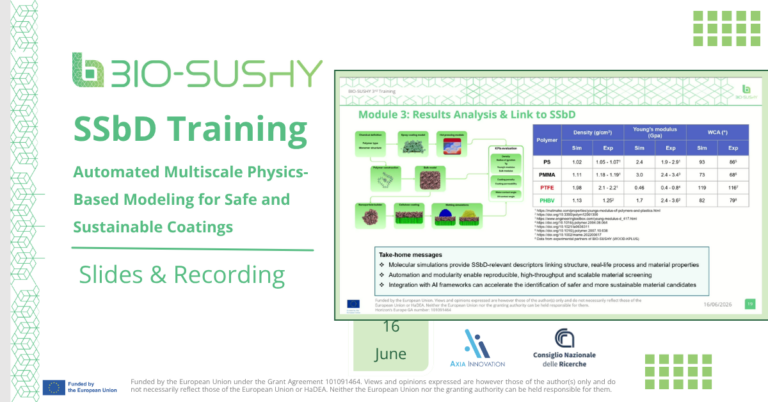
On June 16, 2026, the 3rd BIO-SUSHY training activity was held, focusing on “Introduction to Automated Multiscale Physics-Based Modelling for Safe & Sustainable Coatings.” The training helped explore how computational modelling can accelerate the development of PFAS-free alternatives in key industrial sectors.
Key Takeaways:
- The Mission: Led by Dr. Ioanna Deligkiozi (AXIA Innovation GmbH), the session reiterated BIO-SUSHY’s core objective: replacing hazardous PFAS (“forever chemicals”) in high-performance coatings with safe, sustainable, bio-based alternatives. The project targets three primary markets: textiles, food packaging, and cosmetic glass packaging.
- The Approach: Dr. Andrea Lorenzoni and Dr. Francesco Mercuri from CNR (Consiglio Nazionale delle Ricerche) presented the consortium’s innovative workflow. Their approach relies on modularity, automation, and multiscale physics-based modelling. This methodology links molecular-scale data (chemical composition) directly to macro-scale performance indicators (e.g., water/oil repellency, mechanical strength) and safety metrics.
- Hands-On Demonstration: A major highlight was a live, interactive tutorial using Google Colab. Participants followed a step-by-step process to:
- Build polymer chains from simple inputs (SMILES strings).
- Generate bulk materials and simulate properties like density and Young’s modulus.
- Model the coating of cellulose surfaces and calculate water and oil contact angles.
- The demo demonstrated that these automated workflows can reproduce experimental results, validating their use for screening new bio-based polymers (such as PHBV and PBS) before physical prototyping.
- Try It Yourself: Interested readers and researchers are invited to explore the modular workflow discussed during the webinar. You can access the interactive Google Colab notebook here:
 Try the BIO-SUSHY Modelling Tutorial
 - Integrating Safety & Sustainability: The discussion emphasized how these models fit into the Safe and Sustainable by Design (SSBD) framework. By generating large datasets on material properties and processing impacts early in the R&D phase, the consortium can optimize materials for lower environmental impact (aiming for a 25% reduction) and higher safety without extensive trial-and-error experimentation.
Looking Ahead: The training underscored the potential of digital twins and automated workflows to bridge the gap between material science and industrial application. Full recordings of the session and the Presentations are available on our website.
presentations from the Training
For more details on the BIO-SUSHY project’s progress and upcoming workshops, visit our Website and social media accounts: